Supplements for bloating: which have evidence, and which habits come first
Short answer
Start with habits: NIDDK suggests eating slowly, smaller and more frequent meals, and less gum, fizzy drinks and straws. The supplement evidence we found for bloating is limited. Peppermint oil was studied mostly in people with a diagnosed digestive condition; a ginger trial in 24 healthy adults sped up stomach emptying but found no significant difference in symptoms; magnesium is a laxative ingredient no source tested for bloating.
Key facts
- To reduce gas symptoms, doctors may recommend eating slowly, eating smaller and more frequent meals, and limiting gum, hard candy, fizzy drinks and drinking with a straw. [NIDDK]
- "For safety reasons, talk with your doctor before using supplements, probiotics, or any complementary or alternative medicines or medical practices." [NIDDK]
- Research on peppermint oil has focused mainly on a diagnosed bowel condition; taken by mouth, it can cause heartburn, nausea, abdominal pain and dry mouth. [NCCIH]
- In 24 healthy volunteers, 1,200 mg of ginger cut the stomach's half-emptying time to 13.1 minutes, against 26.7 on placebo, with no significant difference in any gut symptom. [PubMed 18403946]
- Magnesium is a primary ingredient in some laxatives; for adults, the upper limit from supplements and medicines is 350 mg a day. [NIH Office of Dietary Supplements]
- In a 6-week trial of 76 healthy adults, more people improved on a combined bloating, burping and flatulence score with BS50 at 2 billion CFU a day than with a placebo (47.4% vs 22.2%). [Garvey et al., Gut Microbes, 2022]
Which habits come first for bloating? What NIDDK lists
The ones that cut down swallowed air and big loads of gas-forming food. NIDDK, part of the National Institutes of Health, says that "Your doctor may suggest changing your eating and drinking habits to reduce gas symptoms," and lists these.
- Eat slowly, and sit down to eat. NIDDK: eat slowly and, when possible, sit down instead of eating on the run.
- Have smaller meals, more often. Smaller, more frequent meals in place of larger ones, per NIDDK; the NHS adds not to eat large meals late at night.
- Swallow less air. Limit gum, hard candy, fizzy drinks and straws, and avoid talking while you eat or drink (NIDDK). The NHS adds chewing with your mouth closed.
- Notice the gas-forming foods. NIDDK's list includes apples, peaches and pears, fruit juices, broccoli, cauliflower and kale, beans, peas and lentils, milk products, whole wheat, and sweeteners ending in "-ol" such as sorbitol and xylitol. NIDDK also suggests talking with your doctor about your diet; your doctor may ask you to keep a diary of food and symptoms.
- Move, and drink water. The NHS lists regular exercise and drinking plenty of water among its ways to reduce bloating.
"For safety reasons, talk with your doctor before using supplements, probiotics, or any complementary or alternative medicines or medical practices."
NIDDK, Treatment for Gas in the Digestive Tract
Habits come first because they act on the usual sources. NIDDK says gas normally enters the digestive tract when you swallow air and when bacteria in the large intestine break down undigested carbohydrates. If extra gas began when you started a new probiotic, see gas in the first weeks of a probiotic. For gas that is already trapped and hurting, the quick steps are in how to get rid of trapped gas.
Peppermint oil, ginger, magnesium and probiotics: what sources say about bloating
Each row gives what a source says about bloating, in its own scope, and the cautions it lists. Where the only studies we found were in people with a digestive condition, the row says so.
| Supplement | What sources say about bloating | Cautions sources list | Source |
|---|---|---|---|
| Peppermint oil | NCCIH says research on peppermint oil has been small and focused mainly on a diagnosed bowel condition. The studies we found were in people with a digestive condition, which this page does not cover | By mouth: heartburn, nausea, abdominal pain, dry mouth; rarely, allergic reactions. Capsules are often enteric-coated to reduce the chance of heartburn. Ask your provider first if you take any medicine | NCCIH |
| Ginger | One trial in 24 healthy volunteers: 1,200 mg before a soup meal sped up stomach emptying, with no significant difference in any gut symptom. NCCIH's ginger page does not mention bloating | Abdominal discomfort, heartburn, diarrhea, and mouth and throat irritation. Ask your provider before using it with any medicine, or if you are pregnant | Wu et al., 2008; NCCIH |
| Magnesium | No source we checked tested magnesium supplements for bloating. NIH says magnesium is a primary ingredient in some laxatives, which work partly through the osmotic activity of unabsorbed salts in the intestine and colon | High doses from supplements or medicines often cause diarrhea, with nausea and abdominal cramping. Adult upper limit from supplements and medicines: 350 mg a day unless a provider recommends more. Toxicity risk rises with impaired kidney function or kidney failure | NIH Office of Dietary Supplements |
| Probiotics | Choose by strain: NIH ties a probiotic's benefits, if any, to the strains it contains and its CFU count. BS50 at 2 billion CFU a day is one strain studied for bloating; it and the other strains tested in small trials are on our strains page | In healthy people, NIH says, probiotics may cause gas; other problems are rare | NIH Office of Dietary Supplements; Garvey et al., 2022 |
Sources: NCCIH, NIH's Office of Dietary Supplements and two trial records, read on Oct 12, 2026, and for the BS50 trial on Oct 28, 2026. Links below. Rows describe each supplement in general, not one product.
Does peppermint oil help bloating?
We could not answer that for people without a digestive diagnosis. NCCIH says a small amount of research has been done on peppermint oil, mostly in one diagnosed bowel condition, and this page does not cover studies in people with a digestive condition.
What NCCIH says about safety applies to anyone. Peppermint oil appears to be safe when taken by mouth in the doses commonly used, and possible side effects include heartburn, nausea, abdominal pain and dry mouth. Capsules are often enteric-coated to reduce the chance of heartburn. On pregnancy and breastfeeding, NCCIH says little is known about whether peppermint taken by mouth in medicinal amounts is safe.
Does ginger help with bloating?
The one trial we found in healthy adults measured how fast the stomach emptied; the gut symptoms it scored did not differ.
Wu and colleagues (Eur J Gastroenterol Hepatol, 2008) tested 24 healthy volunteers twice, in random order and double-blind: three ginger capsules, 1,200 mg in total, or a placebo, an hour before 500 ml of low-nutrient soup. With ginger, the stomach's half-emptying time was 13.1 minutes, against 26.7 minutes on placebo, and the stomach contracted more often. The volunteers also scored their gut sensations, and "there was no significant difference in any gastrointestinal symptoms."
The authors wrote that the effects "could potentially be beneficial in symptomatic patient groups," which the trial did not test. NCCIH lists ginger's possible side effects as abdominal discomfort, heartburn, diarrhea, and mouth and throat irritation, and says that if you are considering ginger while pregnant, you should consult your health care provider.
Do magnesium supplements help with bloating?
No source we checked tested them for bloating. What NIH's Office of Dietary Supplements does say is that magnesium is a primary ingredient in some laxatives, and that its laxative effect comes partly from the osmotic activity of unabsorbed magnesium salts in the intestine and colon.
That is why the cautions center on the dose. NIH says high doses of magnesium from supplements or medicines often result in diarrhea that can come with nausea and abdominal cramping. For adults, its upper limit for magnesium from supplements and medicines is 350 mg a day, and supplements should not go above it unless a health care provider recommends it. The risk of too much magnesium rises with impaired kidney function or kidney failure, and NIH notes that antibiotics might not be absorbed if taken too soon before or after a magnesium supplement.
When bloating comes with constipation, the AGA's 2023 update says medicines used for constipation should be considered. It names no mineral or product. In our sample of public posts, magnesium came up in 14, nine of them tagged as constipation posts and none as bloating posts. Loose stools after starting a probiotic, and when to call a doctor, are covered in can probiotics cause diarrhea or loose stools?, and harder stools in can probiotics cause constipation?
What about probiotics for bloating?
Choose one whose strain was studied for bloating, and take it at the daily amount its trial used. In a 6-week trial of 76 healthy adults, more people improved on a combined bloating, burping and flatulence score with BS50 at 2 billion CFU a day than with a placebo (47.4% vs 22.2%). The strains that were tested, the trial results and how long they ran are in what is the best probiotic for bloating?
If gas from a new probiotic starts to smell stronger, see smelly gas from probiotics.
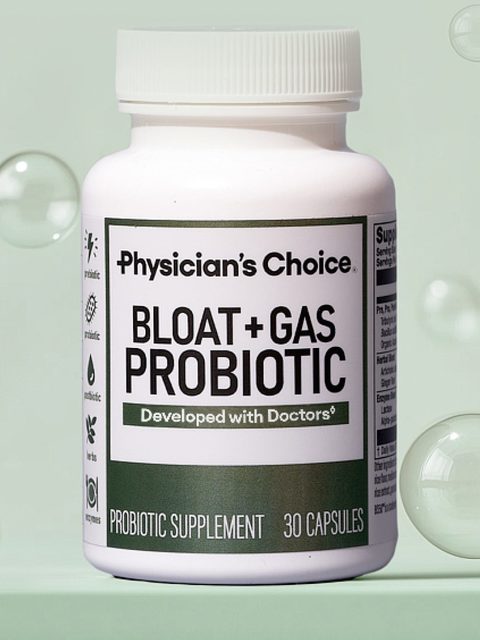
Where Bloat + Gas Probiotic fits
Bloat + Gas Probiotic is made by Physician's Choice, the publisher of this site. The label lists three blends: tributyrin (CoreBiome), B. subtilis OPTIBIOME BS50 at 2 billion CFU and organic acacia, 325 mg in all; artichoke leaf and ginger, 50 mg; and a 36 mg enzyme blend that includes alpha-galactosidase. The ginger trial above gave ginger on its own. No study on this page tested this formula, and the table covers supplements in general, not this one.
The label, blend by blendSee a doctor instead of trying another supplement if
- Gas or bloating bothers you, or your symptoms change suddenly
- It comes with belly pain, constipation or diarrhea
- Bloating keeps coming back, or a change in diet has not helped
- You have blood in your poo, or your weight is dropping when you are not trying
- Bloating comes with vomiting, a high temperature, or a swelling or lump in your tummy
From NIDDK's page on gas symptoms and the NHS page on bloating. The NHS says to ask for an urgent appointment when bloating comes with vomiting, diarrhea, constipation, a stomach ache or a fever.
How we put this together
- What people asked. Of 1,031 public Reddit posts from 228 communities, September 5 to October 5, 2026, 379 were about bloating. Magnesium came up in 14, nine of them about constipation; peppermint and ginger came up in one post each.
- The question. "Supplements for bloating", with the ones searchers name next: magnesium, peppermint oil capsules and ginger.
- Sources. NIDDK, the NHS, NCCIH, NIH's Office of Dietary Supplements, the AGA and one trial record on PubMed, opened on Oct 12, 2026, plus the 2022 BS50 trial, read on Oct 28, 2026. Quotes are copied from each page.
- What we left out. Results from studies in people with a diagnosed digestive condition, and over-the-counter gas medicines, which are a different question.
- Label and wording. One confirmed fact from the Bloat + Gas Probiotic label, and three lines of Physician's Choice approved wording, used word for word.
Common questions
- What is the best supplement for bloating?
- None of the sources we checked names one. NIDDK puts eating habits first: slower, smaller meals and less gum, fizzy drinks and straws. For peppermint oil, ginger and magnesium we found no study that tested bloating in people without a digestive condition. For a probiotic, choose a strain studied for bloating, at the daily amount its trial used. Regular bloating is a reason to see a doctor.
- Does magnesium help with bloating?
- No source we checked tested it for bloating. NIH's Office of Dietary Supplements says magnesium is a primary ingredient in some laxatives and that high doses from supplements often cause diarrhea. The adult upper limit from supplements and medicines is 350 mg a day unless a provider recommends more, and kidney problems raise the risk of too much.
- Do peppermint oil capsules help with bloating?
- The research NCCIH describes on peppermint oil was done mostly in people with a diagnosed digestive condition, which this page does not cover. Taken by mouth, it can cause heartburn, nausea, abdominal pain and dry mouth, and capsules are often enteric-coated to reduce the chance of heartburn. Ask your provider first if you take any medicine.
- Does drinking water help bloating?
- The NHS lists drinking plenty of water among its ways to reduce bloating, along with regular exercise, chewing with your mouth closed and eating smaller, more frequent meals. No source on this page measured water on its own, so it is one habit on a list, not a tested remedy.
Read next
- Do probiotics help you digest lactose? Yogurt cultures, supplement trials and lactose intoleranceWhat yogurt cultures do with lactose.
- What is the best probiotic for bloating? The strains studied, and how long to try oneThe trials behind each strain, and how long to try one.
- Gas in the first weeks of a probiotic: what is normal and when to stopExtra gas after starting a probiotic.
- How to get rid of trapped gas: what helps fast, and what does notWalking, posture, warmth, and when it is urgent.
- Can probiotics cause diarrhea or loose stools?Loose stools after a new probiotic, and when to call.
- Can probiotics cause constipation? What sources say and what to doWhen stools get harder instead.
- Smelly gas from probiotics: why it happens and what to doSulfur, food and medicines.
Sources
- NIDDK: Eating, diet and nutrition for gas in the digestive tractLast reviewed June 2021. Opened Oct 12, 2026.
- NIDDK: Treatment for gas in the digestive tractLast reviewed June 2021. Opened Oct 12, 2026.
- NIDDK: Symptoms and causes of gas in the digestive tractLast reviewed June 2021. Opened Oct 12, 2026.
- NHS: BloatingPage last reviewed 21 January 2026. Opened Oct 12, 2026.
- NCCIH: Peppermint oilLast updated May 2025. Opened Oct 12, 2026.
- NCCIH: GingerLast updated February 2025. Opened Oct 12, 2026.
- Wu KL, et al. Effects of ginger on gastric emptying and motility in healthy humans.Eur J Gastroenterol Hepatol. 2008;20(5):436-40. PMID 18403946. Opened Oct 12, 2026.
- NIH Office of Dietary Supplements: Magnesium, fact sheet for health professionalsUpdated January 6, 2026. Opened Oct 12, 2026.
- NIH Office of Dietary Supplements: Magnesium, fact sheet for consumersUpdated March 22, 2021. Opened Oct 12, 2026.
- American Gastroenterological Association: Evaluation and management of belching, abdominal bloating and distention (clinical practice update)Published July 13, 2023. Opened Oct 12, 2026.
- NIH Office of Dietary Supplements: Probiotics, fact sheet for consumersUpdated November 17, 2025. Opened Oct 12, 2026; read again Oct 28, 2026.
- Garvey SM, et al. The probiotic Bacillus subtilis BS50 decreases gastrointestinal symptoms in healthy adults: a randomized, double-blind, placebo-controlled trial.Gut Microbes. 2022;14(1):2122668. PMC9590435. Opened Oct 28, 2026.
- Physician's Choice: Bloat + Gas Probiotic Supplement Facts panel, on the product page at physicianschoice.comLabel fact checked Oct 12, 2026.