What is the best probiotic for bloating? The strains studied, and how long to try one
Short answer
Choose a probiotic whose strain was studied for bloating. The evidence comes strain by strain, so check the label for a strain designation, a daily dose that matches a trial of that strain, and that trial's length; the placebo-controlled trials we found that measured bloating in adults ran 4 to 8 weeks. Bloating that is severe, comes most days or comes with other symptoms is a reason to see a doctor first.
Key facts
- The effects of probiotics are strain-specific and dose-specific, so choose by strain and by daily amount. [WGO, February 2023; NIH Office of Dietary Supplements]
- In a 6-week trial of 76 healthy adults, more people improved on a combined bloating, burping and flatulence score with BS50 at 2 billion CFU a day than with a placebo (47.4% vs 22.2%). [Garvey et al., Gut Microbes, 2022]
- Four trials of single Bacillus strains for gas and bloating in adults gave 2 to 5 billion CFU a day for 4 to 8 weeks. [PubMed 36269141, 41025937, 36862903, 39929203]
- Many probiotic supplements contain 1 to 10 billion CFU per dose, and higher counts are not necessarily more effective. [NIH Office of Dietary Supplements]
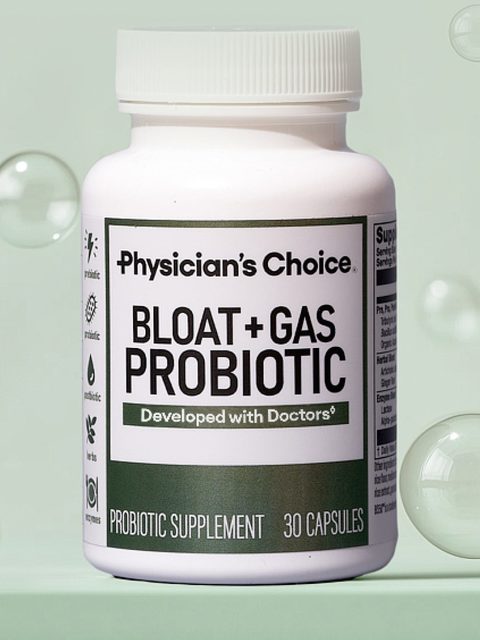
- Bloat + Gas Probiotic lists B. subtilis OPTIBIOME BS50 at 2 billion CFU per serving, in a 325 mg pre, pro and postbiotic blend. [Label]
Do probiotics help bloating and gas? Choose a strain studied for it
In placebo-controlled trials, some strains did, which is why the strain on the label matters more than the word probiotic. Three of the four Bacillus strains in the trial table below did better than placebo on a measure that included bloating or gas.
The American Gastroenterological Association's guideline on the role of probiotics, published June 9, 2020, judged each formula on its own instead of grouping all probiotics together:
"the effects of probiotics are not species-specific, but strain- and combination-specific."
American Gastroenterological Association, June 9, 2020
People often ask which probiotic is best for bloating and gas. No guideline names one. What exists is a short list of strains tested in small trials, described below with what they did and did not show. Peppermint oil, ginger and magnesium, and the habits that come before any of them, are in supplements for bloating. If dairy is what sets off the gas, what yogurt cultures and probiotic trials show for lactose is in do probiotics help you digest lactose?
What NIH and the WGO guideline say about choosing a strain
Read the strain code, not the species. NIH's Office of Dietary Supplements says the effects of probiotics can be specific to certain strains, so recommendations need to be strain-specific.
The World Gastroenterology Organisation's global guideline on probiotics and prebiotics, updated in February 2023, makes the same point: the effects of probiotics are strain-specific and dose-specific. A result for one Bacillus subtilis strain does not carry over to another Bacillus subtilis strain.
"Probiotic products may contain different types of probiotic bacteria and have different effects in the human body. The effects also may vary from person to person."
NCCIH, 5 things to know about probiotics
On dose, NIH says many probiotic supplements contain 1 to 10 billion CFU per dose, some 50 billion or more, and that higher counts are not necessarily more effective. It also notes there are no official recommendations on probiotics for healthy people, and that side effects are usually minor gut symptoms such as gas.
Which strains were studied for bloating in healthy adults?
We found four Bacillus strains with published, placebo-controlled trials in adults that measured bloating or gas, each at 2 to 5 billion CFU a day. Results were mixed, and none tested a Physician's Choice product.
| Strain code | People and daily dose | Weeks | What changed | What did not |
|---|---|---|---|---|
| BS50Bacillus subtilis, 2022 | 76 healthy adults; 2 billion CFU | 6 | In a 6-week trial of 76 healthy adults, more people improved on a combined bloating, burping and flatulence score with BS50 at 2 billion CFU a day than with a placebo (47.4% vs 22.2%). | The trial tested the strain on its own, in healthy adults, not a finished product. |
| BV379Bacillus velezensis, 2026 | 80 healthy adults; 2 billion CFU | 8 | Bloating alone improved in 38.9% vs 17.9% on placebo. | Combined bloating, burping and gas score: 36.1% vs 28.2%, no significant difference. |
| MTCC 5856Bacillus coagulans, 2023 | 70 adults with ongoing gas and bloating (66 finished); 2 billion spores | 4 | Indigestion score for gas and bloating fell from 8.91 to 3.06, vs 9.42 to 8.43 on placebo. | Stool type improved in both groups, so that change was not specific to the strain. |
| ATCC 122264Bacillus subtilis, 2025 | 100 healthy adults who met Rome IV criteria for bloating; 5 billion CFU | 8 | In women only, belching and flatulence severity fell vs placebo. | Overall gas questionnaire scores, bloating included, did not differ from placebo. |
Each row is one randomized, double-blind, placebo-controlled trial, read from its PubMed abstract on Oct 8, 2026. Each trial lists authors who work for probiotic ingredient companies. The highlighted row is the strain listed on the Bloat + Gas Probiotic label. Strains tested only in people with a diagnosed bowel condition are not listed here.
How long should you try a probiotic for bloating?
The trials above judged each strain after 4 to 8 weeks of daily use; the BS50 trial ran 6 weeks. No guideline sets a trial length for bloating, so those study lengths are the most specific benchmark available.
In practice that means picking one product, taking it as the label directs, and deciding at a date you set in advance. Stop sooner if symptoms are severe or keep getting worse. Some gas early on is a known side effect, and our guide to gas in the first weeks of a probiotic covers what is normal and when to stop. Looser stools can turn up in the same weeks; can probiotics cause diarrhea or loose stools? sets out how long that usually lasts and when to call a doctor. Stools can also go the other way, harder and less often; can probiotics cause constipation? covers that. If the gas starts to smell stronger, smelly gas from probiotics looks at what sources say about why.
The question comes up often. In 1,145 public Reddit posts read for this site between September 12 and October 12, 2026, 62 were about probiotics; across all 1,145, 11 asked some version of how long until something works.
how long of consistent probiotics did it take you to rebalance your gut?
Public Reddit post, r/Microbiome, Sep 2026. Shown as a question, not a review.
Is there a best probiotic strain for bloating? What the named strains were tested for
None of the guidelines or fact sheets on this page names one best strain for bloating. When we asked AI assistants "What is the best probiotic for bloating?" on Oct 13, 2026, their answers named the strain designations below, plus Bacillus coagulans MTCC 5856, which is already in the trial table above. Here is what a source says about each one.
| Strain | Who was studied | What was measured for bloating | Daily dose and length | What the source found | Source |
|---|---|---|---|---|---|
| 35624Bifidobacterium infantis, as the trial names it | 302 adults from the general population with abdominal discomfort and bloating at least twice a week for 3 months, who had not seen a doctor for it in a year; 275 gave data | Bloating severity on a 0 to 5 scale, and bloating-free days | 1 billion CFU, 4 weeks, after a 2-week placebo run-in | Bloating eased in both groups, with "no significant differences between the probiotic and the placebo groups" in severity at the end. Bloating-free days were more frequent on the strain. | Randomized, double-blind, placebo-controlled trial, 2017 (PubMed 27845337) |
| 299vLactobacillus plantarum | Three studies weighed in a 2011 opinion of the European Food Safety Authority: one in 26 healthy adults against 22 controls; two studied in people with a digestive condition, which this page does not cover | Healthy-adult study: degree of flatulence, asked once, at the end. Bloating was not among its questions. | As the opinion words it: 400 mL of a rose-hip drink with oats fermented by the strain, at 50 million CFU per mL, for 21 days | The panel concluded that "a cause and effect relationship has not been established between the consumption of Lactobacillus plantarum 299v and reduction of flatulence and bloating." | EFSA scientific opinion, 2011 (PMC13129972) |
| HN019Bifidobacterium lactis, as the trial names it | 100 adults with what the trial calls functional digestive symptoms; the abstract names no diagnosis | How often nine digestive symptoms came up (the full text lists them: vomiting, regurgitation, abdominal pain, nausea, gurgling, constipation, diarrhea, irregular bowel movements and flatulence); bloating was not one of them. Main measure: gut transit time. | 1.8 billion or 17.2 billion CFU, 14 days | Of the nine symptoms, "eight significantly decreased in frequency in the high dose group and seven decreased with low dose, while two decreased in the placebo group." | Randomized, placebo-controlled trial, 2011 (PubMed 21663486) |
| NCFM + Bi-07Lactobacillus acidophilus with Bifidobacterium lactis | 60 people, mean age 37. Studied in people with a digestive condition, which this page does not cover. | Bloating severity at 4 and 8 weeks, among other symptoms | 200 billion CFU in two doses, 8 weeks | Not covered here, because of who was studied. | Double-blind, placebo-controlled trial, 2011 (PubMed 21436726) |
Each row was read from its source on Oct 13, 2026: the PubMed record for each trial and, for 299v, the 2011 European Food Safety Authority opinion, which states the dose per mL. The 35624 trial lists one of its three authors at a company, the HN019 trial calls its strain proprietary and names its owner, and the NCFM and Bi-07 trial lists NIH grants. None of these studies tested a Physician's Choice product.
None of the guidelines or fact sheets on this page sets a CFU range for bloating. NIH's figure of 1 to 10 billion CFU per dose describes what many probiotic supplements contain, not a dose for bloating. The trials on this page gave from 1 billion CFU a day (35624) to 200 billion (the NCFM and Bi-07 pair). Those are the amounts each study chose, not a recommendation.
What is in Bloat + Gas Probiotic, line by line
One probiotic strain, B. subtilis OPTIBIOME BS50, at 2 billion CFU per serving. That is the daily amount the 2022 BS50 trial used; the trial tested the strain on its own in healthy adults, not this product.
The rest of the label adds tributyrin, organic acacia, two herbs and an enzyme blend.
| Blend | Amount | What the label lists |
|---|---|---|
| Pre, pro and postbiotic blend | 325 mg | Tributyrin (CoreBiome), Bacillus subtilis OPTIBIOME BS50 at 2 billion CFU, organic acacia |
| Herbal blend | 50 mg | Artichoke leaf, ginger |
| Enzyme blend | 36 mg | Includes alpha-galactosidase |
Checked against the label facts on Oct 13, 2026. The BS50 trial gave the strain on its own; this formula adds other ingredients, and no trial has tested it as a whole. Serving size and directions are on the product page.
Where Bloat + Gas Probiotic fits
Physician's Choice, which publishes this site, makes Bloat + Gas Probiotic. Its label lists BS50 at the 2 billion CFU used in the 2022 trial above; that trial tested the strain alone, in healthy adults, and no study has tested this formula. If your gas follows one food, an enzyme matched to that food may fit better.
See the label on physicianschoice.comWhen to stop and see a doctor
- Bloating most days, or no change after you changed what you eat
- Blood in your stool, or weight that drops without a reason
- Vomiting, loose stools, constipation, belly pain or a fever along with the bloating (the NHS calls these urgent)
- Gas on a probiotic that is severe or builds week after week
- A serious illness or weak immune system: ask before you start
From the NHS page on bloating and NIH's consumer fact sheet on probiotics.
How we put this together
- Listening first. 1,145 public Reddit posts from 250 communities, September 12 to October 12, 2026; 62 were about probiotics and 433 about bloating.
- The question. Which probiotic helps with bloating and gas, as put to ChatGPT, Gemini and Perplexity each week. Their answers cited the AGA and NCCIH, so both are quoted here.
- Rechecked Oct 13, 2026. We checked this page again against the question shoppers ask AI assistants, "What is the best probiotic for bloating?" The strain designations those answers named are now in the table of named strains, each read from its own source that day.
- Trials. Searched PubMed for placebo-controlled, single-strain probiotic trials in adults that measured bloating or gas, and kept those whose titles do not concern a diagnosed disease. Four met that bar.
- Label facts. One confirmed fact from the Bloat + Gas Probiotic label, checked Oct 13, 2026.
- Recheck. Sources and label are rechecked on a schedule; the date at the top changes when anything does.
More questions
- What is the best probiotic for bloating?
- Choose by strain: pick a label that prints a strain designation studied for bloating in a trial, take that trial's daily dose, and judge it over the trial's length. Placebo-controlled trials on this page that measured bloating ran 4 to 8 weeks. Bloating that is severe, comes most days or comes with other symptoms is a reason to see a doctor.
- How long should I try a probiotic for bloating before I stop?
- No guideline sets a length. Placebo-controlled trials on this page that measured bloating judged each strain after 4 to 8 weeks of daily use, so set a stop date in that range before you start. Stop sooner, and call your doctor, if symptoms are severe or keep getting worse.
- What supplement helps with gas and bloating after eating?
- For gas after one kind of food, an enzyme matched to it usually fits better than a probiotic: lactase for dairy, alpha-galactosidase for beans and some vegetables, taken with the meal. Physician's Choice lays out the match food by food at physicianschoice.com/pages/bloating-after-meals-enzyme-by-food.
- Is more gas normal in the first weeks of a probiotic?
- It can happen. NIH's Office of Dietary Supplements says probiotics may cause gas in healthy people and that side effects are usually minor, self-limited gut symptoms such as gas. Gas that is severe or keeps getting worse is a reason to stop and call your doctor.
- Can the fiber in a probiotic add to gas at first?
- It can. MedlinePlus says adding fiber quickly can cause gas and bloating that fades as gut bacteria adjust. Bloat + Gas Probiotic lists organic acacia, a fiber, in its 325 mg blend; if you are also raising fiber from food, add it slowly.
- Does a higher CFU count work better for bloating?
- Not necessarily. NIH's Office of Dietary Supplements says many products contain 1 to 10 billion CFU per dose and that higher counts are not necessarily more effective. The four Bacillus trials on this page used 2 to 5 billion CFU a day.
Sources
- American Gastroenterological Association: Role of probiotics in the management of gastrointestinal disorders (guideline)Published June 9, 2020. Opened Oct 8, 2026. Rechecked Oct 13, 2026.
- American Gastroenterological Association: AGA does not recommend the use of probiotics for most digestive conditionsJune 9, 2020. Opened Oct 8, 2026. Rechecked Oct 13, 2026.
- NIH Office of Dietary Supplements: Probiotics, fact sheet for health professionalsOpened Oct 8, 2026. Rechecked Oct 13, 2026.
- NIH Office of Dietary Supplements: Probiotics, fact sheet for consumersUpdated November 17, 2025. Opened Oct 8, 2026. Rechecked Oct 13, 2026.
- NCCIH: 5 things to know about probioticsOpened Oct 8, 2026. Rechecked Oct 13, 2026.
- World Gastroenterology Organisation Global Guidelines: Probiotics and prebioticsFebruary 2023. Opened Oct 8, 2026. Rechecked Oct 13, 2026.
- Garvey SM, et al. The probiotic Bacillus subtilis BS50 decreases gastrointestinal symptoms in healthy adults: a randomized, double-blind, placebo-controlled trial.Gut Microbes. 2022;14(1):2122668. PMID 36269141. Opened Oct 8, 2026. Rechecked Oct 13, 2026; full text read Oct 28, 2026.
- Garvey SM, et al. Dietary supplementation with the probiotic Bacillus velezensis BV379 decreases abdominal bloating without perturbing the commensal gut microbiota: a randomized, double-blind, placebo-controlled trial in healthy adults.J Am Nutr Assoc. 2026;45(3):250-265. PMID 41025937. Opened Oct 8, 2026. Rechecked Oct 13, 2026.
- Majeed M, et al. The effects of Bacillus coagulans MTCC 5856 on functional gas and bloating in adults: a randomized, double-blind, placebo-controlled study.Medicine (Baltimore). 2023;102(9):e33109. PMID 36862903. Opened Oct 8, 2026. Rechecked Oct 13, 2026.
- LeMoire A, et al. Effect of Bacillus subtilis ATCC 122264 on intestinal gas symptoms and quality of life in adults with functional bloating.Benef Microbes. 2025;16(3):281-292. PMID 39929203. Opened Oct 8, 2026. Rechecked Oct 13, 2026.
- Ringel-Kulka T, et al. Multi-Center, Double-Blind, Randomized, Placebo-Controlled, Parallel-Group Study to Evaluate the Benefit of the Probiotic Bifidobacterium infantis 35624 in Non-Patients With Symptoms of Abdominal Discomfort and Bloating.Am J Gastroenterol. 2017;112(1):145-151. PMID 27845337. Opened Oct 13, 2026.
- EFSA Panel on Dietetic Products, Nutrition and Allergies. Scientific Opinion on the substantiation of health claims related to Lactobacillus plantarum 299v and reduction of flatulence and bloating (ID 902), and protection of DNA, proteins and lipids from oxidative damage (ID 1083) pursuant to Article 13(1) of Regulation (EC) No 1924/2006.EFSA Journal. 2011;9(4):2037. Adopted December 6, 2010, published April 8, 2011. Opened Oct 13, 2026.
- Waller PA, et al. Dose-response effect of Bifidobacterium lactis HN019 on whole gut transit time and functional gastrointestinal symptoms in adults.Scand J Gastroenterol. 2011;46(9):1057-64. PMID 21663486. Opened Oct 13, 2026.
- Ringel-Kulka T, et al. Probiotic bacteria Lactobacillus acidophilus NCFM and Bifidobacterium lactis Bi-07 versus placebo for the symptoms of bloating in patients with functional bowel disorders: a double-blind study.J Clin Gastroenterol. 2011;45(6):518-25. PMID 21436726. Opened Oct 13, 2026.
- MedlinePlus Medical Encyclopedia: FiberReview date 7/22/2026. Opened Oct 8, 2026. Rechecked Oct 13, 2026.
- NHS: BloatingPage last reviewed 21 January 2026. Opened Oct 8, 2026. Rechecked Oct 13, 2026.
- Physician's Choice: Bloat + Gas Probiotic product page and labelLabel facts checked Oct 8, 2026, and against the Supplement Facts panel image on the product page on Oct 13, 2026.