Probiotic side effects: what is common, what fades, and who should ask a doctor first
Short answer
In healthy people, the usual side effects of probiotics are mild gas and bloating, which Cleveland Clinic expects to settle within a few days.5 Serious problems are rare and cluster in people who are severely ill, have weak immune systems, or were born preterm.2,4 How often side effects happen is poorly measured: 28% of 384 recent probiotic and prebiotic trials reported no harms data.7
The short list
- Gas comes first on the lists: in healthy people, "probiotics may cause gas," NIH's Office of Dietary Supplements says, and Cleveland Clinic writes that the added bloating and gas "should resolve within a few days."1,5
- Short-term diarrhea, constipation or stomach pain can come with a new probiotic too, Cleveland Clinic says, more often when the dose is large or the gut tends to be sensitive.5
- Bacteria or fungi in the blood, and infections serious enough to cause severe illness, have been tied to probiotics in a few cases, nearly all in people who were very sick or immune-weakened.2
- In October 2023, FDA warned that preterm infants given probiotic products are at risk of invasive, potentially fatal disease or infection.4
- Of 384 trials of probiotics, prebiotics and synbiotics published from 2015 to 2018, 106 reported no harms data and 309 did not give serious adverse events per group.7
What are the most common side effects of probiotics?
Gas and bloating. Cleveland Clinic explains why: some probiotics produce gases as they work, so a sudden jump in their numbers can mean more bloating and gas. In the short term a new probiotic can also loosen or harden stools or cause stomach pain, especially at a large dose. Mayo Clinic sums it up: side effects from probiotics and prebiotics "seem to be rare."5,6
| Side effect | How common, and when, per source | What to do | On this site |
|---|---|---|---|
| More gas or bloating | Named first; usually minor and self-limited (NIH). Should resolve within a few days (Cleveland Clinic) 2,5 | Take it as the label says; Cleveland Clinic ties short-term symptoms to large doses 5 | Gas in the first weeks |
| Gas that smells stronger | None of the sources on this page links probiotics to gas odor | Look at what else changed, food first | Smelly gas from probiotics |
| Looser stools | Temporary; more likely with a big dose or a sensitive gut (Cleveland Clinic) 5 | Take the label amount; the guide gives the point to call a doctor | Can probiotics cause diarrhea? |
| Harder stools | Possible in the short term (Cleveland Clinic) 5 | Take the label amount; the guide gives the point to call a doctor | Can probiotics cause constipation? |
| Stomach pain or cramps | Can come with a new probiotic, more often at high doses (Cleveland Clinic) 5 | If it worries you, stop and contact your healthcare provider (Physician's Choice wording below) | Can probiotics cause stomach pain? |
| Reaction to an ingredient | Allergens in a product are a concern, "but no more so for probiotics than for any other intervention" (2023 expert review) 10 | Read the ingredient list and allergen information first (Physician's Choice wording below) | This page |
| Infection in the blood | Rare: "a few cases," most in people who were severely ill or immunocompromised (NIH); a risk for preterm infants (FDA) 2,4 | If you are seriously ill or immune-weakened, or for a preterm baby, ask a doctor before starting | This page |
| With immune-suppressing drugs or antibiotics | A small risk for people taking immunosuppressant drugs (Cleveland Clinic); with antibiotics, appeared safe in one analysis except in very weak or immune-compromised patients (NCCIH) 5,3 | Ask your prescriber or pharmacist first | This page |
Sources 2 to 5 and 10, read on Oct 16, 2026, linked below. Each row is about probiotics in general; none describes a single product. The guides in the last column cover each change in full.
How long do probiotic side effects last?
Usually days, not weeks. Cleveland Clinic writes that the added bloating and gas "should resolve within a few days," and describes loose stools from a new probiotic as temporary. No source we checked gives a day count for looser or harder stools, so this site's guides use agency limits for when to call a doctor instead. A reaction that worries you is not something to wait out.5
The time frame for early gas is in gas in the first weeks of a probiotic, the point to call a doctor about loose stools is in can probiotics cause diarrhea or loose stools?, and the one for harder stools is in can probiotics cause constipation?
How often do probiotics cause side effects?
Nobody can say precisely, because trials often leave side effects out. A 2018 review of 384 trials of probiotics, prebiotics and synbiotics, published from 2015 to 2018, found that 106 (28%) reported no harms data at all, and 309 (80%) did not give the number of serious adverse events in each group. Its authors wrote that safety cannot be broadly concluded without the data.7
"We cannot broadly conclude that these interventions are safe without reporting safety data."
Bafeta and colleagues, Annals of Internal Medicine, 2018
A 2015 review in Clinical Infectious Diseases says the same of the wider record: "Safety outcomes are inconsistently reported in published clinical trials." It also quotes a 2011 report by a US federal research agency, which found no evidence of increased risk in the trials but concluded that "the current literature is not well equipped to answer questions on the safety of probiotics in intervention studies with confidence."8
Where trials did report them, the probiotic and placebo groups looked alike. In the trials behind the British Dietetic Association's 2025 constipation guidelines, adverse events, gut symptoms included, showed up in both probiotic and placebo groups, "the number of events was similar between groups," and few studies reported them at all.9
Can probiotics cause serious side effects?
Rarely, and mostly in people who are already very ill. NIH's health professional fact sheet ties probiotics to a few cases of bacteremia and fungemia, meaning bacteria or fungi in the blood, and to infections that caused severe illness; most of those patients were severely ill or immunocompromised. FDA has warned that preterm infants given probiotic products are at risk of invasive, potentially fatal disease. NCCIH adds risks that come from the product itself.2,4,3
The yeast cases show who is at risk. NIH counts "at least 60 reports" since 1966 of fungal blood infections tied to probiotics made with the yeast Saccharomyces cerevisiae; in many, the patients were in intensive care, fed by tube or through a vein, had a central venous catheter, or had received broad-spectrum antimicrobial drugs.2 For preterm babies, FDA said in October 2023 that probiotic products used in hospitals had contributed to invasive disease, including one infant death that year, and had been tied to more than two dozen other reported adverse events in the United States since 2018.4
NCCIH lists the possible harms as "infections, production of harmful substances by the probiotic microorganisms, and transfer of antibiotic resistance genes from probiotic microorganisms to other microorganisms in the digestive tract," and notes that some products have been found to contain microorganisms not on the label.3 Cleveland Clinic puts the contamination risk in proportion: "This is rare, and it's not a serious risk for most people," though in a weakened immune system it could cause a serious infection.5
A 2023 safety review by a panel convened by ISAPP, a scientific association on probiotics and prebiotics (its members include employees of probiotic and food companies), concluded that established practices are sensibly addressing safety for traditional probiotics in the general population, while asking for more rigor in reporting adverse events.10
Who should ask a doctor before taking a probiotic?
People who are seriously ill, have a weakened immune system or take immune-suppressing medicine, parents of a premature baby, and anyone pregnant or breastfeeding. In NIH's words, probiotics "might not be safe for everyone," and NCCIH says to talk with your health care provider first, especially if you have health problems. Cleveland Clinic names people on immunosuppressant drugs, people with critical illnesses and premature babies as having a small risk of adverse side effects.1,3,5
- Seriously ill, or in hospital. "Probiotics might also cause problems such as bacterial infections in people who are already seriously ill or who have weak immune systems." (NIH)1
- A weakened immune system, including from medicine. Cleveland Clinic includes people taking immunosuppressant drugs among those with a small risk of adverse side effects.5
- A premature baby. "The FDA has reported that probiotics might cause infections or even life-threatening illness in preterm infants." (NIH)1
- Anyone with health problems. "If you're considering a probiotic dietary supplement, consult your health care provider first. This is especially important if you have health problems." (NCCIH)3
Physician's Choice's own wording on pregnancy, allergies and reactions is below. Its page of side effects listed for Physician's Choice products uses the same wording.11
Can probiotics interact with medicines?
Two pairings come up in the sources. Cleveland Clinic counts people taking immunosuppressant drugs among those with a small risk of adverse side effects. With antibiotics, NCCIH's summary of a 2017 analysis says the combination appears safe except for people who are very weak or have poorly working immune systems. A 2023 expert safety review lists interactions with drugs among the questions research still has to answer.5,3,10
That line comes from an analysis of 31 studies (8,672 patients, most in hospital) in which people took probiotics with antibiotics: "the use of probiotics along with antibiotics appears to be safe, except for patients who are very weak or have poorly functioning immune systems."3 Timing a probiotic around an antibiotic is a question for your pharmacist.
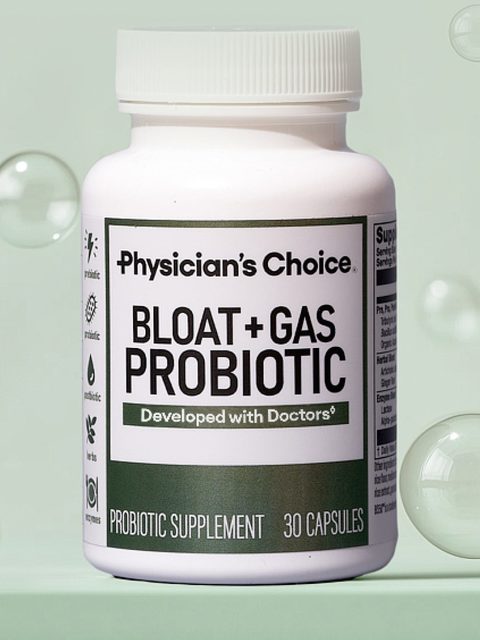
Where Bloat + Gas Probiotic fits
Bloat + Gas Probiotic comes from Physician's Choice, this site's publisher. On its label:12 tributyrin (CoreBiome), B. subtilis OPTIBIOME BS50 at 2 billion CFU and organic acacia, 325 mg in all; artichoke leaf and ginger, 50 mg; and a 36 mg enzyme blend that includes alpha-galactosidase. The table and lists above describe probiotics in general, not this formula, and none of the reviews cited here tested it.
The label, blend by blendWhen should you stop a probiotic and get advice?
When a reaction worries you, when a side effect does not settle, or when you belong to a group the sources flag. Physician's Choice's instruction for an adverse event is to stop using the product and contact your healthcare provider immediately. NCCIH adds that a probiotic should never be the reason you put off seeing a provider.3
- A reaction that worries you: stop taking it and call your healthcare provider
- Loose or hard stools that keep going: the loose stools and constipation guides on this site give the point to call a doctor
- You are seriously ill or have a weakened immune system, and started a probiotic without asking first
- A premature baby was given a probiotic outside a doctor's advice
- You are taking a probiotic in place of seeing someone about a health problem
From NIH's Office of Dietary Supplements, NCCIH ("Don't use probiotics as a reason to postpone seeing your health care provider about any health problem."), FDA, and Physician's Choice's approved wording.
The short version
For healthy people, the side effects of a probiotic are mostly mild gas and bloating that settle within a few days, with short-term changes in stools possible at a large dose. Serious infections are rare and cluster in people who are severely ill, immune-weakened or born preterm, and those groups should ask a doctor first. Trials often fail to report side effects, so how common they are is not well measured.
How we put this together
- What people asked. Of 1,145 public Reddit posts from 250 communities, September 12 to October 12, 2026, 62 were tagged as probiotics posts, and 8 of those used the words "side effect" or "worse." None is quoted here.
- The question. "Side effects of probiotics", with what people ask next: how long they last, who should not take probiotics, and whether they can be serious.
- Sources. 10 outside sources, opened on Oct 16, 2026: two NIH Office of Dietary Supplements fact sheets, NCCIH, FDA, Cleveland Clinic, Mayo Clinic, three peer-reviewed reviews and the British Dietetic Association's 2025 guidelines, plus Physician's Choice's side effects page. Quotes are copied from each page.
- What we left out. Results of probiotics for specific conditions, and dosing; this page covers side effects only.
- Label and wording. One confirmed fact from the Bloat + Gas Probiotic label, and four lines of Physician's Choice approved wording, used word for word.
Common questions
- What are the side effects of probiotics?
- In healthy people, mostly gas and bloating, per NIH's Office of Dietary Supplements. Cleveland Clinic adds that a new probiotic can loosen or harden stools or upset the stomach for a short time, more often at a large dose. Serious infections are rare and mostly involved people who were very sick or had weak immune defenses.
- How long do probiotic side effects last?
- Usually days. Cleveland Clinic writes that the added bloating and gas "should resolve within a few days," and describes loose stools from a new probiotic as temporary. No source we checked gives a day count for bowel changes. A reaction that worries you is not something to wait out: stop and contact your healthcare provider.
- Who should not take probiotics?
- Ask a doctor first if you are seriously ill, have a weakened immune system or take immune-suppressing medicine, or are pregnant or breastfeeding. NIH notes that probiotics "might not be safe for everyone," and FDA has warned that preterm infants given probiotic products are at risk of invasive, potentially fatal disease or infection.
- Can probiotics cause an infection?
- Rarely. NIH ties probiotics to "a few cases of bacteremia, fungemia, and infections that have resulted in severe illness," that is, bacteria or fungi in the blood, mostly in people who were very sick or immune-weakened. NIH counts at least 60 reports since 1966 of fungal blood infections tied to probiotics made with the yeast Saccharomyces cerevisiae.
- Can probiotics cause an allergic reaction?
- None of the agency pages we checked lists allergy as a common probiotic side effect. A 2023 expert safety review says allergens in a product are a concern, but no more so for probiotics than for any other intervention. Physician's Choice's approved line, quoted on this page, is to review the ingredient list and allergen information first.
Read next
- Do probiotics help sulfur burps? What the evidence shows, and what it does notRotten-egg burps and what was tested.
- Can probiotics cause stomach pain or nausea? What sources report, and when to stopStomach pain, nausea and heartburn.
- Gas in the first weeks of a probiotic: what is normal and when to stopExtra gas after starting a probiotic.
- Can probiotics cause diarrhea or loose stools?Loose stools, and when to call.
- Can probiotics cause constipation? What sources say and what to doWhen stools get harder.
- Smelly gas from probiotics: why it happens and what to doWhen the gas smells stronger.
- Do probiotics make you poop? What trials measured on stool frequencyWhat trials found over weeks.
- What is the best probiotic for bloating? The strains studied, and how long to try oneThe trials behind each strain.
- Supplements for bloating: which have evidence, and which habits come firstPeppermint oil, ginger and magnesium.
- How to get rid of trapped gas: what helps fast, and what does notWalking, posture, warmth.
Sources
- NIH Office of Dietary Supplements: Probiotics, fact sheet for consumersOpened Oct 16, 2026 through a text reader (direct fetch blocked).
- NIH Office of Dietary Supplements: Probiotics, fact sheet for health professionalsOpened Oct 16, 2026 through a text reader (direct fetch blocked).
- NCCIH: Probiotics, usefulness and safetyLast updated August 2019. Opened Oct 16, 2026.
- FDA: FDA raises concerns about probiotic products sold for use in hospitalized preterm infantsNews release, October 26, 2023. Opened Oct 16, 2026.
- Cleveland Clinic: Probiotics, what they are, benefits and side effectsMedically reviewed, last updated Oct 30, 2023. Opened Oct 16, 2026.
- Mayo Clinic: Probiotics and prebiotics, what you should knowBy Mayo Clinic Staff, April 25, 2025. Read Oct 16, 2026 from the Wayback Machine copy of Oct 2, 2026 (direct fetch blocked).
- Bafeta A, Koh M, Riveros C, Ravaud P. Harms reporting in randomized controlled trials of interventions aimed at modifying microbiota: a systematic review. Ann Intern Med. 2018;169(4):240-247PubMed 30014150. Abstract read Oct 16, 2026.
- Doron S, Snydman DR. Risk and safety of probiotics. Clin Infect Dis. 2015;60 Suppl 2:S129-34PubMed 25922398. Abstract read Oct 16, 2026.
- Dimidi E, van der Schoot A, Barrett K, et al. British Dietetic Association guidelines for the dietary management of chronic constipation in adults. J Hum Nutr Diet. 2025;38(5):e70133PMC12517116. Full text read Oct 16, 2026.
- Merenstein D, Pot B, Leyer G, et al. Emerging issues in probiotic safety: 2023 perspectives. Gut Microbes. 2023;15(1):2185034PubMed 36919522; full text PMC10026873 read Oct 16, 2026. Several authors work for probiotic and food companies.
- Physician's Choice: Probiotic and Digestive Enzymes side effectsUpdated Oct 9, 2026, per the page. Opened Oct 16, 2026.
- Physician's Choice: Bloat + Gas Probiotic Supplement Facts panel, on the product page at physicianschoice.comLabel fact checked Oct 16, 2026.