Can probiotics cause constipation? What sources say and what to do
Short answer
Sometimes, for a short time. Cleveland Clinic says starting a new probiotic can bring on constipation in the short term, more often at a large dose or with a sensitive gut. No source we checked says how many days it lasts. MedlinePlus says to contact your provider if you have not had a bowel movement in 3 days, or if you are bloated or have stomach pain.
Key facts
- A large dose, or a gut that tends to be sensitive, makes short-term constipation from a new probiotic more likely. [Cleveland Clinic]
- Constipation can mean fewer than three bowel movements a week, hard, dry or lumpy stools, stools that are hard to pass, or a sense that not all stool has passed. [NIDDK]
- Bowel habits differ from person to person, and "only you know what's normal for you." [NIDDK]
- Iron supplements and antacids that contain aluminum and calcium are among the products that can make constipation worse. [NIDDK]
- When constipated, drink 8 to 10 cups (2 to 2.5 L) of liquids a day, particularly water. [MedlinePlus]
- Constipation with blood in your stool, constant belly pain, vomiting or fever needs a doctor right away. [NIDDK]
What do Cleveland Clinic and NIH say about probiotics and constipation?
That it can happen early on, and that probiotic side effects tend to be mild. Under the question "Can probiotics cause diarrhea, constipation or stomach pain?", Cleveland Clinic answers that
"in the short term, it's possible that introducing new probiotics could trigger similar symptoms"
Cleveland Clinic, Probiotics
The same page says the odds go up with a large dose, or when your gut tends to be sensitive in general. In wording Physician's Choice has approved for its pages: According to the NIH Office of Dietary Supplements, probiotics are generally well tolerated by healthy people, though they may cause mild digestive symptoms, such as gas. Probiotics may not be appropriate for everyone, particularly people who are seriously ill or have weakened immune systems. Talk with your healthcare provider before use.
Two things the sources leave open. Cleveland Clinic explains why a new probiotic can loosen stools or add gas, but offers no reason for constipation. And no one has counted how often it happens: NCCIH notes that few studies have examined probiotic safety in detail, so solid figures on how often side effects occur are missing.
How long does constipation from a probiotic last?
No source we checked gives a number of days. Cleveland Clinic says only "in the short term," and NIDDK says constipation of any cause "may last for a short or long time."
One line is easy to misread. Cleveland Clinic does give a time for one side effect: extra gas and bloating "should resolve within a few days." That time frame is about gas and bloating; the page gives none for constipation, and this page does not borrow it.
So go by what you notice, not the calendar. MedlinePlus says to contact your provider if you have not had a bowel movement in 3 days, and NIDDK says to see a doctor when symptoms do not go away with self-care. Physician's Choice puts it this way: If constipation does not get better with changes to what you eat and drink, talk to your doctor.
Looser stools are the other common change; can probiotics cause diarrhea or loose stools? covers them, and gas in the first weeks of a probiotic covers gas. Gas that smells stronger is a separate question, taken up in smelly gas from probiotics. What longer trials measured on stool frequency in adults who were already constipated is in do probiotics make you poop?
What you notice, how long sources say it lasts, and what to do
Each row takes one change you might notice after starting a probiotic and sets out what the sources say about how long it lasts, what to do, and when a doctor should hear about it.
| What you notice | How long sources say it lasts | What to do | When to call a doctor |
|---|---|---|---|
| Fewer bowel movements than usual for you | "In the short term" (Cleveland Clinic); no source we checked gives a day count | 8 to 10 cups of liquids a day, particularly water; walk or move at least 3 or 4 times a week (MedlinePlus) | No bowel movement in 3 days (MedlinePlus) |
| Hard, dry or lumpy stools | Constipation "may last for a short or long time" (NIDDK) | Add fiber from food a little at a time, with plenty of liquids to help the fiber work (NIDDK) | Not better with self-care (NIDDK) or with changes to what you eat and drink (Physician's Choice) |
| Straining, or feeling not all stool has passed | The sources we checked give no time frame | Go when you feel the urge; try a set time each day, such as after breakfast (MedlinePlus, NIDDK) | Bleeding from your rectum or blood in your stool: right away (NIDDK) |
| Bloating or belly discomfort along with it | For gas and bloating from a new probiotic, a few days (Cleveland Clinic); no time is given for constipation | Note what else changed that week (see below) | Bloated or stomach pain while constipated (MedlinePlus); constant belly pain, no gas passing, vomiting or fever: right away (NIDDK) |
| A reaction that worries you | Not something to wait out | Stop the product and contact your healthcare provider (Physician's Choice note below) | Right away |
Sources: Cleveland Clinic, NIDDK and MedlinePlus, read on Oct 10, 2026, and wording approved by Physician's Choice. Links below. The rows apply to any new probiotic, not to one product.
Could something else be behind it?
Look at the rest of your week first. NIDDK lists many causes of constipation, and several of them tend to change at the same time as a new supplement.
Other pills. NIDDK names iron supplements, antacids that contain aluminum and calcium, and several prescription medicines among the products that can make constipation worse. MedlinePlus adds that some medicines, and even some vitamins, can constipate you.
Your routine. Bowel movements can change when you travel, change your medicines, change how much and what you eat, or ignore the urge to go, NIDDK says. Too little fiber, too few liquids and too little physical activity are on its list as well.
If a probiotic, an iron pill and a new eating plan all started in the same week, the probiotic may not be the cause. NIDDK's advice is to talk with your doctor if you think a supplement is behind it:
"Don't change or stop any medicine or supplement without talking with a health care professional."
NIDDK, on constipation and supplements
What helps if you feel constipated after starting a probiotic?
The everyday steps for any constipation, with the probiotic kept at the label amount while you try them.
- Check the amount. Cleveland Clinic links short-term stomach symptoms to large doses and says to take a probiotic as recommended on the label.
- Drink more. MedlinePlus suggests 8 to 10 cups (2 to 2.5 L) of liquids a day, particularly water, while you are constipated.
- Add fiber slowly. NIDDK says to add fiber a little at a time so your body gets used to it, and MedlinePlus warns that more fiber can cause bloating and gas.
- Move. Walk, swim or do something active at least 3 or 4 times a week, MedlinePlus says.
- Keep a routine. Trying for a bowel movement 15 to 45 minutes after breakfast may help, NIDDK says, because eating helps your colon move stool.
- Ask before a laxative. MedlinePlus says to take a laxative only as often as your provider recommends, and that pregnant or breastfeeding women and children under 6 should not take laxatives without a provider's advice.
Magnesium, an ingredient in some laxatives that is also sold as a supplement, has its own upper limit; see supplements for bloating.
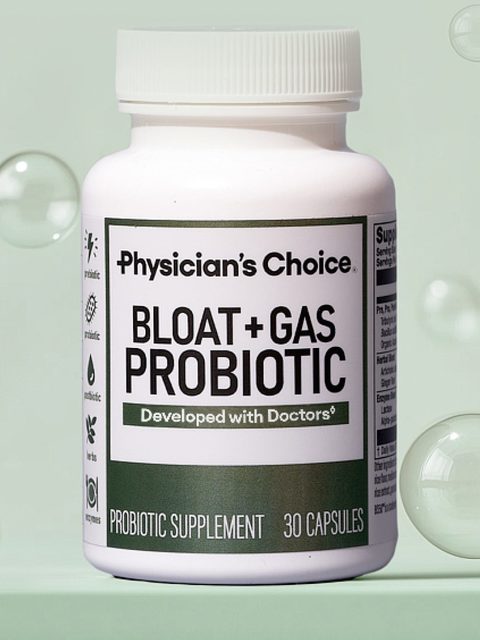
Where Bloat + Gas Probiotic fits
The publisher of this site, Physician's Choice, makes Bloat + Gas Probiotic. Its label has three blends: 325 mg combining tributyrin (CoreBiome), B. subtilis OPTIBIOME BS50 at 2 billion CFU and organic acacia; 50 mg of artichoke leaf and ginger; and 36 mg of enzymes, alpha-galactosidase among them. The steps and the table above are general guidance for any probiotic you start; they do not describe this product. What the BS50 strain trial measured is in our answer on the strains studied for bloating.
Every blend, line by lineSee a doctor right away if you are constipated and
- You see blood in your stool, or bleeding from your rectum
- Pain in your belly is constant
- You cannot pass gas
- You are vomiting or have a fever
- You have lower back pain, or your weight is dropping without trying
From NIDDK's page on the symptoms and causes of constipation. NIDDK also advises seeing a doctor if symptoms do not go away with self-care, or if colon or rectal cancer runs in your family.
How we put this together
- What people asked. Of 1,031 public Reddit posts from 228 communities, September 5 to October 5, 2026, 401 were about constipation and 63 about probiotics; 9 were about both.
- The question. "Can probiotics cause constipation?" and three that searchers ask next: what too much probiotic feels like, whether probiotics change bowel movements, and what to do.
- Sources. Cleveland Clinic, NIH's Office of Dietary Supplements and NCCIH, NIDDK, MedlinePlus and ISAPP, opened on Oct 10, 2026. Quotes are copied from each page.
- Label and wording. The product details come from one confirmed fact on the Bloat + Gas Probiotic label. The NIH summary, the doctor line and the two lines in the note above are Physician's Choice's approved wording, used word for word.
- Recheck. Each recheck updates the Last checked date at the top of the page.
Quick answers
- What are the symptoms of too much probiotics?
- No source we checked sets a "too much" dose. Cleveland Clinic ties short-term diarrhea, constipation and stomach pain to large doses and to guts that tend to be sensitive, and says to take a probiotic as recommended on the label. NIDDK advises a doctor's visit when self-care has not helped.
- Do probiotics change your bowel movements?
- They can, at first, in either direction: Cleveland Clinic lists both diarrhea and constipation as possible short-term effects of a new probiotic. Over longer periods, trials that tested probiotics for constipation found results that differ from one probiotic to another; ISAPP, a scientific association on probiotics, says "not all probiotics have the same effects in constipation."
- Should I stop my probiotic if I get constipated?
- Talk it through first. NIDDK says to talk with your doctor if you think a supplement is causing constipation, and not to change or stop any medicine or supplement without a health care professional. Get help right away for blood in your stool, constant belly pain or a reaction that worries you.
- Is it normal to poop less when starting probiotics?
- It can happen for a short time, Cleveland Clinic says. NIDDK notes that bowel patterns differ and only you know what is normal for you, so compare with your own usual pattern. MedlinePlus says to contact your provider if you have not had a bowel movement in 3 days.
Read next
- Do probiotics make you poop? What trials measured on stool frequencyWhat weeks of use did to stool frequency in trials.
- Can probiotics cause diarrhea or loose stools?The opposite change, its time frame, and the point to call a doctor.
- Gas in the first weeks of a probiotic: what is normal and when to stopEarly gas, and when to stop.
- What is the best probiotic for bloating? The strains studied, and how long to try oneStrains, trial lengths and the BS50 study.
- Smelly gas from probiotics: why it happens and what to doWhy gas smells, and what sources say about probiotics.
Sources
- Cleveland Clinic: Probiotics, what they are, benefits and side effectsMedically reviewed, last updated Oct 30, 2023. Opened Oct 10, 2026.
- NIH Office of Dietary Supplements: Probiotics, fact sheet for consumersOpened Oct 10, 2026.
- NCCIH: Probiotics, usefulness and safetyLast updated August 2019. Opened Oct 10, 2026.
- ISAPP: Are probiotics effective in improving symptoms of constipation?By Eirini Dimidi, PhD, RD. Updated June 21, 2025. Opened Oct 10, 2026.
- NIDDK: Definition and facts for constipationLast reviewed May 2018. Opened Oct 10, 2026.
- NIDDK: Symptoms and causes of constipationLast reviewed May 2018. Opened Oct 10, 2026.
- NIDDK: Treatment for constipationLast reviewed May 2018. Opened Oct 10, 2026.
- NIDDK: Eating, diet and nutrition for constipationLast reviewed May 2018. Opened Oct 10, 2026.
- MedlinePlus: Constipation, self-careOpened Oct 10, 2026.
- Physician's Choice: Bloat + Gas Probiotic Supplement Facts panel, on the product page at physicianschoice.comLabel fact checked Oct 10, 2026.